
Challenges in organising and using company knowledge
Many companies face the task of making their internal knowledge effectively accessible. A common problem is the fragmentation of information across different departments and systems. Important information is often scattered across departments and systems and is difficult to access beyond their boundaries. This fragmentation not only hampers efficiency but also delays decision-making and increases the risk of errors.
Another problem is the impending loss of knowledge caused by experienced employees retiring or experts moving on. The Wissenssicherungsmonitor 2020 (Knowledge Retention Monitor 2020) describes the wave of retirements of the baby boomer generation: year after year, many experienced specialists and managers leave their companies, often taking with them knowledge that is documented nowhere. This applies above all to experience that is hard to document and to expert knowledge that, due to inadequate retention, cannot be transferred systematically.
In addition, the sheer volume of available data is a growing obstacle. Many companies generate large amounts of unstructured data every day – emails, reports, specifications – that can hardly be used in a targeted way without structure. This volume of data overwhelms traditional knowledge management systems and makes it difficult to extract and use relevant knowledge in a targeted way.
Solutions that reduce fragmentation, secure knowledge and structure large volumes of data are therefore essential to make companies more capable of acting and more efficient.
What is a knowledge graph?
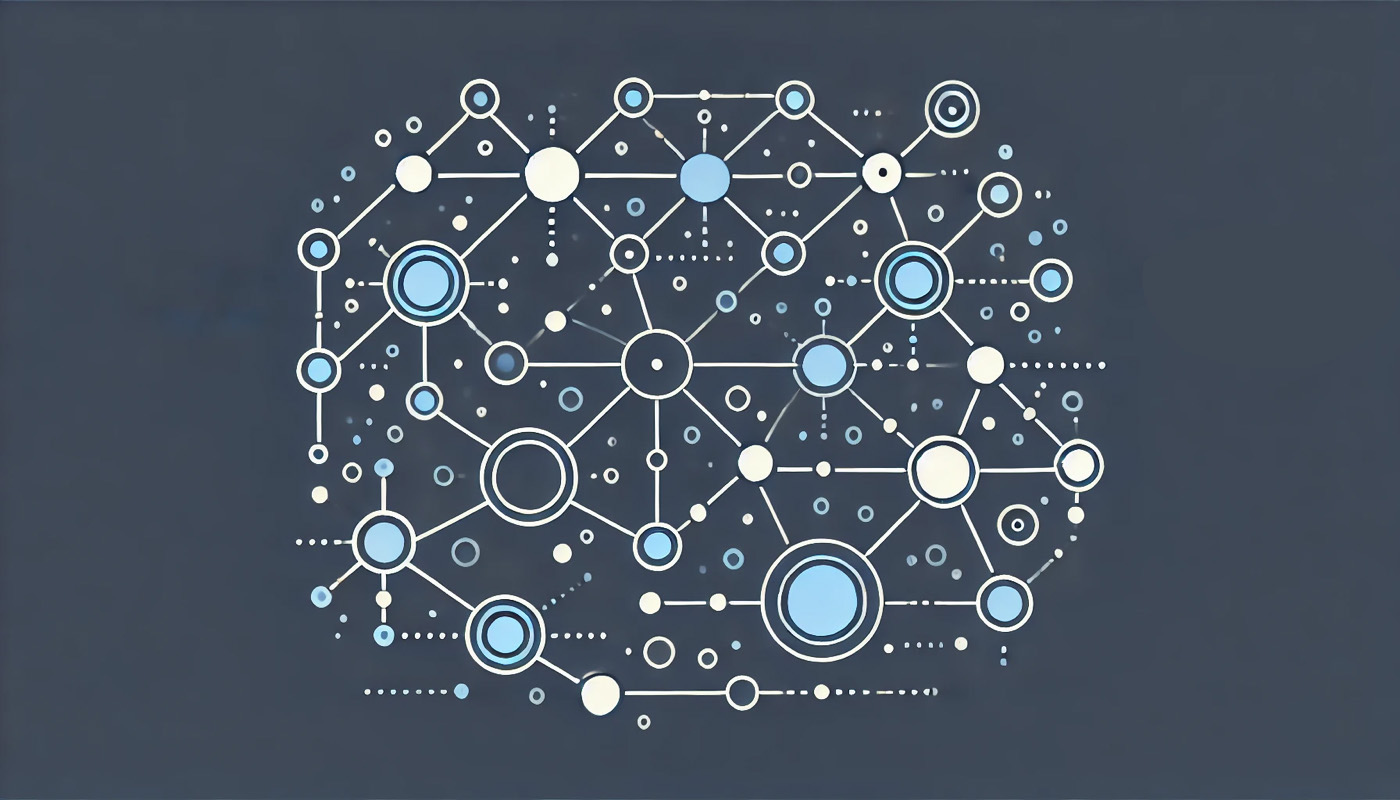
A knowledge graph is a data-driven model that structures information and represents the relationships between entities. Entities can be people, products, processes or other relevant elements of a company. Unlike classic databases, which store information linearly, a knowledge graph focuses on the connections and context of the data. This makes it possible not only to retrieve information but also to understand its meaning in the wider context.
The basic principle of a knowledge graph is to link data points through semantic relationships. These semantic relationships – for example, “Product X is part of product family Y” or “Customer A is interested in category B” – create a network that does not store knowledge in isolation but integrates it and makes it intelligently usable.
Another advantage of a knowledge graph is its ability to discover new connections between data points that were previously not obvious. Once such connections become visible, processes can be improved in a more targeted way and new business opportunities can be identified.
A knowledge graph also differs from traditional database solutions in its scalability. While relational databases often reach their limits as data volumes grow, knowledge graphs can easily grow with them thanks to their flexible structure. This property makes them ideal for companies operating in dynamic, data-intensive industries.
Overall, the knowledge graph is a key innovation for not merely storing data but making it accessible as connected, actionable knowledge. Its ability to bring context and meaning to the fore makes it a valuable tool for modern organisations.
How does a knowledge graph work?
A knowledge graph is based on a data structure that represents information in the form of entities (nodes) and their relationships (edges). This structure differs fundamentally from conventional relational databases, which are primarily table-based. By representing data points as linked entities, a knowledge graph makes it possible to depict complex networks of the kind that frequently occur in real business processes.
At its core, a knowledge graph works with semantic links. Each entity – such as a product, a supplier or a standard – is not just stored as an isolated piece of information but defined in relation to other entities. An example: a product can be linked to its technical specifications, the components used, the responsible suppliers and the customer projects in which it is installed. The result is a data-driven model that fully maps the relationships between elements in a company.
The concept of a knowledge graph makes it possible to answer questions that go beyond simple data queries. If a component has to be replaced, for example, a knowledge graph can identify not only the products in which the component is used but also the affected customer projects and possible alternative components. This ability to make dependencies and impacts visible in real time is a key advantage over traditional data models.

A decisive feature of a knowledge graph is its adaptability. New entities or relationships can be added without affecting the existing structure. This is a great advantage, particularly in dynamic environments such as product development or variant management. The flexible structure allows the graph to be continuously adapted to new requirements without costly restructuring.
Another important aspect is the integration of ontologies. These define the meaning of entities and their relationships and ensure that all data in the graph can be interpreted consistently. This semantic foundation makes it possible to recognise patterns and new relationships in the data that were previously hidden.
A knowledge graph’s ability to bring together and link data from different sources makes it an indispensable tool for companies working with complex processes and large volumes of data. This integration of context, flexibility and connection offers clear added value over classic database systems.
Benefits of a knowledge graph
Using a knowledge graph offers companies a wide range of benefits, particularly when managing and using large, complex volumes of data. Through its ability not only to store information but also to connect it in its context, a knowledge graph creates a foundation for well-founded decisions and efficient processes.
1. Improved data integration
A knowledge graph makes it possible to combine data from different sources and formats in one central structure. This is especially important in companies where information is often stored in silos, whether in different departments, systems or databases. By linking this data, a consistent and coherent view of the entire company knowledge emerges. Integration not only provides greater transparency but also makes it easier to access relevant information across departments.
2. Context-based decision-making
Traditional database systems often deliver isolated pieces of information that have to be painstakingly assembled into an overall picture. Knowledge graphs, by contrast, present data directly in context. Relationships between entities, such as between a product, its components, suppliers and quality standards, are immediately visible. This makes it possible to recognise potential problems or opportunities more quickly and to make well-founded decisions.
3. Greater efficiency through more precise search results
Thanks to their semantic structure, knowledge graphs can deliver much more precise search results. Instead of having to dig through large volumes of data, users receive targeted answers that take into account the relationships between the relevant data points. For example, a query for products with specific technical properties can directly show all relevant documents, suppliers and alternative components.
4. Scalability and flexibility
Unlike classic databases, whose structure is often rigid, a knowledge graph offers a high degree of flexibility. New data points or relationships can be added seamlessly without affecting existing structures. This property makes knowledge graphs particularly suitable for industries with rapidly changing requirements, such as medical technology or the automotive industry.
5. Pattern recognition and automation
The semantic foundation of a knowledge graph makes it possible to recognise hidden patterns in the data. By integrating ontologies and using machine learning algorithms, companies can identify dependencies or trends that remain undetected in traditional systems. These insights can help to optimise processes or open up new business areas.
6. Reduction of data redundancy
In many companies, data is stored and processed multiple times, which leads to inconsistencies and increased effort. Knowledge graphs eliminate this redundancy by storing information centrally and making it accessible through links. This not only improves data quality but also reduces administrative effort.
Knowledge graphs not only offer technical advantages but also contribute directly to improving company performance. Their ability to connect data intelligently and make it usable sets them apart from traditional systems and makes them an indispensable tool for modern organisations.
Applications in companies
Knowledge graphs offer companies versatile applications that go far beyond simple data management. Their ability to connect information and put it into the right context opens up new ways to optimise processes, foster innovation and improve decision-making. Here are some key areas of application:
1. Knowledge management and documentation
Many companies struggle with the challenge of making knowledge accessible across departments and locations. A knowledge graph can centrally organise and link all business-relevant information – from technical documentation to guidelines and experiential knowledge. As a result, employees find the information they need more quickly, which increases efficiency and drastically reduces the time spent searching.
Example: A medical technology company can link regulatory requirements, product documentation and research reports in order to accelerate approval procedures and ensure compliance.
2. Product and variant management
In industries such as automotive or mechanical engineering, managing product variants is a complex task. Knowledge graphs can help to link all variants of a product with their specific features, the components used and the relevant supply chains. This not only improves clarity but also makes it possible to analyse variants efficiently and uncover optimisation potential.
Example: By using a knowledge graph, a car manufacturer can identify which components are used across several models and thus reduce costs through standardised production processes.
3. Customer service and support
A knowledge graph can significantly improve customer service by providing information on products, frequently asked questions and customer interactions in one central structure. Customer enquiries can be handled more quickly because service staff have immediate access to all relevant data.
Example: A telecommunications company could use a knowledge graph to link customer feedback, technical specifications and proposed solutions in order to resolve problems in real time.
4. Supply chain and logistics optimisation
Managing complex supply chains requires a comprehensive overview of suppliers, production sites and transport routes. Knowledge graphs can map this information in a dynamic structure that makes dependencies and risks visible. This enables proactive supply chain management and minimises downtime.
Example: A logistics service provider could identify potential bottlenecks by linking supplier information with real-time data on transport routes.
5. Fostering innovation and research
By connecting research data, market analyses and internal projects, companies can make their innovation processes more efficient. Knowledge graphs make it possible to recognise trends and relationships more quickly and to develop new ideas in a targeted way.
Example: A pharmaceutical company can link study results, active substance data and market requirements in order to bring new medicines to market more quickly.
6. Compliance and risk management
Regulatory requirements are a challenge in many industries. Knowledge graphs can help to ensure compliance by bringing relevant regulations, guidelines and internal processes together in one central structure. This allows risks to be identified early and necessary measures to be implemented more quickly.
Example: A financial services provider could link regulatory requirements with internal processes to ensure that all operations comply with the applicable regulations.
Knowledge graphs therefore offer flexible and powerful solutions that can be tailored to a company’s individual needs. The possible applications are as varied as the challenges modern organisations face.

Knowledge as a competitive advantage
A knowledge graph is far more than a technical solution – it is a tool that enables companies to transform their data and information into valuable knowledge. By connecting entities, putting information into context and making it intuitively accessible, a knowledge graph creates clarity where complexity used to dominate.
However, implementing and optimising a knowledge graph requires expertise. This is where bluesolve comes in: with our experience in knowledge management, data processing and semantic analysis, we support companies in planning, developing and implementing tailored knowledge graph solutions.
Whether you are looking to get started with the topic, want to optimise existing processes or already face specific challenges in knowledge management – bluesolve offers you the right tools and approaches to achieve your goals. Together, we make sure that your company does not just store information but uses it as a competitive advantage.
Contact us and find out how we can make your knowledge graph the engine of your efficiency and innovation.
Further reading: W3C – RDF 1.1 Primer.